 |
| The Pitch Lake |
Thursday, February 4, 2016
Conclusion of Trinidad and Tobago
Overall, my trip to Trinidad and Tobago was a tremendous success. I learned all that I came to learn, and I saw all I needed to see. My favorite part was the variety of food that I got to eat. But, mostly I liked the subdued island feel that all the tourists desire. But, the culture was not too subdued in order to not be exciting. I liked my whole trip. There were not any travel disasters neither were there any sicknesses. I got to see all the countries that I was assigned and I got to spend adequate time in each one. Lastly I would gladly go back to each one of them.

Trinidad and Tobago day 2
 |
| A steel band |
Today, I woke up feeling relaxed and well rested. I decided to go get some breakfast. For breakfast, I had some sliced fruit with coffee. After breakfast, I decided to go back to the same park as the day before in order to see some more good music. The band at the park was playing some delightful african folk music with some parang songs too. Parang is a mix between african and spanish music. The next band up was playing soca music. Soca is a mix between calypso and indian melodies. They also played a rapso song. Rapso is calypso influenced by reggae. Then, they played some chutney. Chutney is based off of traditional Indian wedding music. Lastly, they played a finale song that was soca-chutney. The indian music in Trinidad and Tobago has surged in popularity ever since Bollywood movies have gone global. Also, more Christian/Hindu music has started creeping in since Canadian missionaries came to the islands and converted many Hindus. Bollywood has also played a part in the popularity surge for indian dancing. But, waltzes and ballets are still favored by the higher classes. The higher classes usually are in the oil business or asphalt. Trinidad is home to the largest asphalt bog in the world. Also, the islands are the United States’s largest importer of liquefied natural gas as well as being home to the largest methanol plant in the world. After sitting in the park, I ate some curried chicken, potatoes, chickpeas, and flatbread for lunch. After lunch, I went and grabbed a nice, cold, refreshing ginger beer. Then, I went down to a theater and watched a long play in which the african dance, the bele was performed. In the mid-afternoon, I had to check out of my hotel and drive to the airport. But I went and got a goodbye meal of chow mein before I boarded my flight back to America.
Trinidad and Tobago day 1
 |
| Port-of-Spain |
Intro to Trinidad and Tobago
 |
| Piarco International Airport |
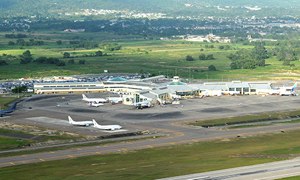
I am on the approach into Piarco international airport on Trinidad. This entry will be the intro for the last of the three countries that I have been assigned to investigate by National Geographic. Here is what I know. The island Nation is the largest and most populated in the Southern Caribbean. Trinidad was discovered by Christopher Columbus in 1498. Tobago was in the hands of France, Spain, The Netherlands, Britain, and Courland (modern Latvia). The island changed hands 22 times. Great Britain gained Trinidad in 1797 and Tobago in 1814. Trinidad is separated from Venezuela by the two ten mile wide straits of the Dragon’s Tongue and the Serpent’s Tongue. In modern times, the British abolished slavery and brought in workers from India to replace the slaves. Now, the country has a diverse population of Spaniards, Brits, Afros, and Indians. There are no surviving members of the indigenous population. Oil was discovered off the coasts of both islands in 1910 and since has become a major part of the economy. I hope to learn more about the music and dancing.
Conclusion of Peru
I really liked Peru. The country was so captivating, even the name sounds exotic. I wish that I could have stayed longer, but I have a job to do that limits my stay in each country. In all honesty, I liked touring all the old buildings and eating the good food. At many points in Peru, I just wanted to sit down and soak in the entire country. But, I had to keep moving because I only had two days to eat, see, and hear everything I wanted. Lastly, I enjoyed being along the coast of the country and then moving up into the Andes Range where I could experience the mountain culture.
 |
| Machu Pichu |
Peru day 2
 |
| Cuzco is a World Heritage Site too |
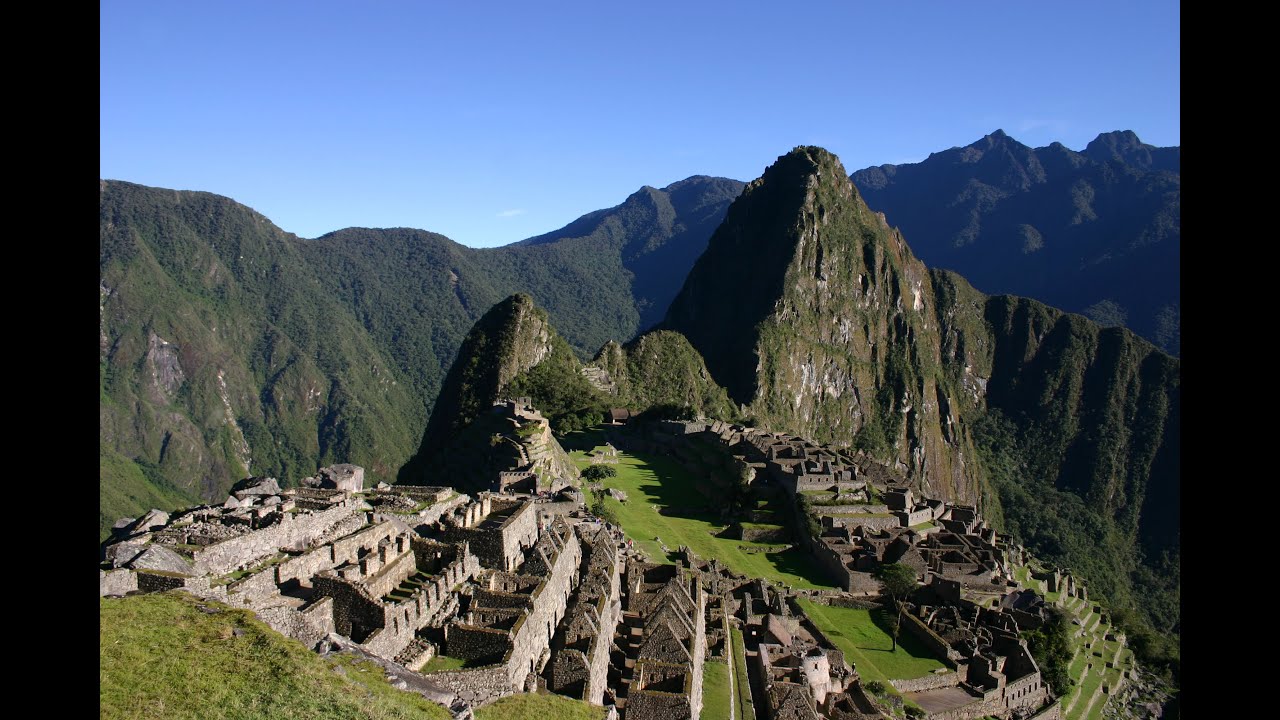
Today, I landed in Cuzco and went to the hotel. After a long rest, I ambled through town. Cuzco was once a great cultural center and capital of the Inca empire. The city is said to have originally be built in the shape of a Puma. For breakfast I was not hungry so I grabbed some coffee and headed off on my excursion to Machu Picchu. The sprawling mountain-top city provided a great vista to look down from. Not surprisingly, there were lots of llamas there. There were also a plethora of natives playing pan flutes and dancing. There were less armed guards around the site despite the problem of shining path militants. For awhile I sat and watched the flute players dance around . I also watched the llamas. Then, I ate the lunch I had packed. I ate a Peruvian-Japanese dish of tiraditos, thin fish with sauces. I also had causa, filled potato puree rolls. After lunch, I drove back to Cuzco in time to go see some of the ancient buildings. The most impressive detail of the buildings was how the boulders used to build the buildings fit together and stuck without cement or mortar. These buildings were likely used to perform religious ceremonies. The Koricancha was a temple with pure gold painted on the walls which the Spaniards plundered and took to Spain. Many of the Incas were killed just prior to Pizarro’s arrival due to a civil war. The estimated population of Cuzco at his arrival is roughly 200,000. Plus, a lot of the population died off after smallpox was introduced. Finally I ate dinner. For dinner I had anticuchos, marinated and grilled beef heart on sticks. The meal was actually quite delicious. For dessert I had sliced fruit. Finally, I drove to the airport to catch my flight to Trinidad and Tobago.
Peru day 1
 |
| Lima's coastline |
I woke up in my hotel in Lima and decided to go out for breakfast. At breakfast, I had the national dish of Peru, ceviche, Seabass marinated in lime juice served with chilies, boiled potato, and boiled corn. As a drink, I had a Peruvian soda called “Inca Kola.” Then, I went for a walk. On my walk, I saw a couple of American tourists complaining about how they could not go to the Andes slopes because they were scared of the paramilitary group “Shining Path.” Shining Path is a militant group who started fighting the Peruvian government in the 1980s. The insurgency of Shining Path has cost over 30,000 lives. The conversation made me notice armed soldiers appearing every once in awhile as I walked. After an hour or so, I ended back up at my hotel where I checked out and made my way toward somewhere to eat lunch. I eventually found a small restaurant on a quiet corner of old town. The lunch was a delight to all the senses. My lunch was a modest meal of cod fish and chicha morada, a non-alcoholic drink made from purple corn cobs. Next to me was a local drinking maize beer. After lunch, I kept walking through town on my way to the airport. On my way, I spotted a family of serranos, poor Amerindians who live with their families. The Amerindians moved into Lima in the 1950s. Many of the poorer families work in the fish processing plants or the factories that surround downtown. Even now you can see how encomienda is still around. The lower castes are still poor, mestizos are still the bulk of the middle of the middle class, and the higher classes are made up of unmixed europeans. In Callao, I stopped and ate dinner. For the first course, I ate arroz chaufa, rice with fried egg and swordfish along with some fried calamari. From the restaurant, I hopped on my flight to Cuzco.
Subscribe to:
Comments (Atom)